
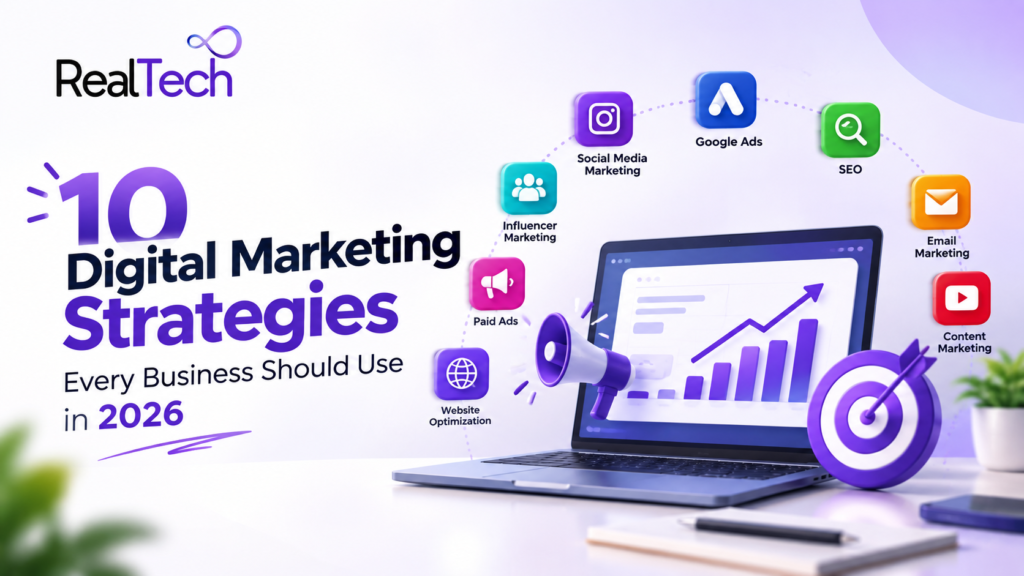
10 Digital Marketing Strategies Every Business Should Use in 2026
Digital marketing in 2026 is not about being present on every platform.
It is about building a system where the right customer can discover your business, understand your value, trust your brand, contact you easily and move toward a decision without unnecessary friction.
That system is changing quickly.
Google Search is becoming more conversational through AI. Advertising platforms are automating more campaign decisions. Short-form video has become a major discovery channel. Customers increasingly expect immediate communication through messaging platforms. And businesses now have access to more marketing data than ever before.
The challenge is no longer finding enough marketing tools.
It is knowing which strategies actually deserve your attention.
Here are ten digital marketing strategies businesses should focus on in 2026.
1. Create Content People Actually Search For
SEO is changing, but it is far from disappearing.
People are simply searching differently.
Google’s AI Mode has surpassed one billion monthly users, and AI Overviews reaches more than 2.5 billion monthly users. Search is increasingly moving from short keyword queries toward longer, conversational questions.
This means businesses should stop creating articles purely because a keyword has search volume.
Instead, build content around real customer questions.
A real estate company might answer:
What documents should I check before buying a plot?
A restaurant might answer:
How do I choose a venue for a corporate dinner?
A B2B company might explain:
Why am I generating leads but not converting them?
Google itself continues to recommend helpful, reliable, people-first content rather than material created primarily to manipulate rankings.
The businesses that become genuinely useful sources of information will have a much stronger foundation for both traditional SEO and AI-powered discovery.
2. Treat Short-Form Video as a Discovery Channel
Reels and short videos should no longer be treated as occasional social-media content.
They are becoming a major way customers discover products, businesses, creators and ideas.
Meta’s 2026 India research reports that Reels has become a major discovery environment, including strong daily usage across Gen Z and broader audiences. Meta also reports meaningful influence from Reels on product discovery and purchase decisions in India.
But businesses should avoid turning every Reel into an advertisement.
A useful content mix might include:
Educational content
Behind-the-scenes execution
Customer questions
Case studies
Founder insights
Product demonstrations
Industry observations
Customer experiences
The goal is to create content people would willingly watch even if they were not already planning to buy.
Attention comes before conversion.
3. Let AI Optimise Ads — But Don’t Let It Decide Your Strategy
Meta and Google are increasingly using AI to automate targeting, bidding, creative selection and campaign delivery.
Google’s AI Max, for example, can expand beyond existing keywords and match advertising with relevant searches and landing pages. Meta is similarly expanding AI-powered ad ranking and creative optimisation.
That changes the marketer’s job.
Constantly adjusting targeting settings is becoming less important.
Giving the system better inputs is becoming more important.
That means businesses should invest more attention in:
The offer.
The creative.
The landing page.
The customer data.
The conversion tracking.
AI can identify who is more likely to respond to an advertisement.
It cannot decide whether your offer is compelling.
A weak campaign automated perfectly is still a weak campaign.
4. Build a Website for Conversion, Not Decoration
A beautiful website that does not generate enquiries is an expensive brochure.
In 2026, a business website should perform several jobs at once.
It should explain what the business does quickly, establish credibility, answer important questions, demonstrate expertise and guide visitors toward a clear next action.
Every important page should make the next step obvious.
That might be:
Book a consultation.
Send a WhatsApp message.
Request a quotation.
Schedule a visit.
Download information.
Purchase a product.
Avoid overwhelming visitors with five equally important buttons.
Good website design is not simply about making something visually impressive.
It is about reducing the distance between interest and action.
This is also why website design, UI/UX, SEO, advertising and conversion strategy should not operate independently.
They influence the same customer journey.
5. Connect Marketing With Your CRM
One of the biggest mistakes businesses make is measuring marketing only until the lead is generated.
Imagine two campaigns.
Campaign A generates 500 leads.
Campaign B generates 180.
At first glance, Campaign A appears stronger.
But what happens if Campaign B produces twice as many actual customers?
Without connecting marketing data to a CRM or sales system, the business may never know.
In 2026, serious digital marketing should track more than:
Clicks
Reach
Followers
Cost per lead
Businesses should also understand:
Lead quality
Follow-up status
Appointments or visits
Conversions
Revenue
Repeat business
Marketing becomes significantly more valuable when the business can identify which campaign actually produced revenue, not simply which campaign produced the cheapest enquiry.
6. Reduce the Time Between Enquiry and Response
A customer who contacts a business today expects speed.
If somebody enquires through Instagram or WhatsApp and receives a response several hours later, the business may already be competing with three others.
This is where automation can create enormous value.
Meta is expanding AI-powered Business Agents that can answer business-specific questions, qualify leads, recommend products, book appointments and transfer conversations to human team members when needed. Meta reported in June 2026 that more than one million businesses were already using Business Agents across WhatsApp and Messenger.
Businesses do not need to automate every conversation.
They should automate the delay.
An immediate acknowledgement, basic qualification and intelligent routing can happen automatically.
Human teams can then focus on conversations where judgment, relationships and negotiation actually matter.
7. Take Local Search Seriously
For businesses serving a particular city or region, Google Business Profile remains one of the most practical digital marketing assets available.
Google says local results are influenced primarily by relevance, distance and prominence, while complete business information, reviews and accurate details can help customers discover local businesses through Search and Maps.
That means maintaining a Business Profile should not be a one-time setup exercise.
Businesses should regularly update:
Business details
Photos and videos
Services
Website information
Operating hours
Customer reviews and responses
A customer searching for a service nearby is often much closer to making a decision than somebody casually scrolling social media.
Local visibility therefore deserves its own strategy.
8. Use Creators for Trust, Not Just Reach
Influencer marketing works best when businesses stop asking:
“Who has the most followers?”
and start asking:
“Whose audience actually matters to us?”
A regional business may achieve more from a trusted local creator with 25,000 relevant followers than from a national influencer followed by one million people who have little connection to the product.
The same applies to niche industries.
A finance creator, property educator, food blogger, technology reviewer or local city page brings context as well as reach.
In 2026, creator collaborations should be selected based on:
Audience relevance, geography, credibility, engagement and campaign objective.
The objective should not always be immediate sales either.
Creators can help with discovery, trust, product education, event promotion and social proof.
9. Build a Recognisable Brand Before Producing More Content
AI has made content production easier than ever.
That also means customers are seeing more content than ever.
The solution is not simply producing even more.
It is becoming easier to recognise.
A business should have consistency across its:
Website
Social media
Advertisements
Videos
Sales presentations
Messaging
Events
Customer communication
The same brand should feel familiar wherever the customer encounters it.
This becomes particularly important as AI-generated creative increases the amount of generic-looking content in the market.
Technology can help businesses produce faster.
Brand identity helps people remember who produced it.
10. Measure the Customer Journey, Not Individual Platforms
Instagram will tell you about engagement.
Google Ads will tell you about clicks.
Meta Ads will report conversions.
Your CRM will tell you about leads.
Sales will tell you about revenue.
Looking at any one of these independently provides only part of the story.
The smarter approach is to look at the complete journey:
Discovery → Engagement → Enquiry → Follow-up → Conversion → Revenue
This also prevents businesses from chasing vanity metrics.
A Reel with 200,000 views may create little business.
A video with 8,000 views may generate several valuable customers.
A campaign with a higher cost per lead may ultimately generate substantially more revenue.
Digital marketing should therefore be measured against the business objective—not simply against the metric a platform makes easiest to see.
The Best Strategy in 2026? Connect Everything.
The biggest mistake businesses can make in 2026 is treating every part of digital marketing as a separate activity.
Content without strategy becomes noise.
Advertising without a strong offer becomes expensive.
A website without conversion thinking becomes decoration.
Leads without follow-up become wasted opportunities.
Automation without good customer experience becomes frustrating.
And data without interpretation becomes another dashboard nobody uses.
The businesses that grow through digital marketing will increasingly be those that connect these pieces into one system.
That means combining content, search, advertising, technology, CRM, automation, branding and customer experience around the same business objective.
Because digital marketing in 2026 is no longer simply about getting attention.
It is about knowing what to do after you get it.
Bringing Strategy, Technology and Execution Together
At RealTech, we approach digital marketing as part of a complete business ecosystem.
From digital campaigns, branding and content to websites, UI/UX, lead generation, CRM, automation, influencer marketing and events, our focus is on connecting the different parts of the customer journey rather than treating them as isolated services.
Because businesses rarely need another marketing tool.
They need the right tools working together.
RealTech
marketing.technology.events.